
Continuous Air Quality and Noise Monitoring for Airports
Airports operate under relentless operational pressure. Aircraft taxiing, heavy ground support fleets, and landside access roads create complex emission footprints that drift into surrounding residential communities. Relying on a single regulatory reference cabin leaves miles of perimeter completely unmonitored. Bettair deploys dense grids of compact, multi-pollutant nodes across airfields and fence lines. You gain continuous, time-stamped records of gases, particulate matter, and acoustic levels without civil engineering works or costly routine maintenance.
Environmental Monitoring Challenges in Airports
Airfield emissions do not follow steady patterns. Short-duration peaks of nitrogen dioxide, ultrafine soot, and acoustic spikes erupt during aircraft rotation, pushback, and engine run-up tests. Single fixed cabins cannot pinpoint which apron operations cause perimeter spikes. Without directional wind tracking synchronized with high-density measurements, environmental directors cannot distinguish aircraft exhaust from adjacent highway congestion when addressing community grievances.
Airports combine aircraft activity, ground vehicles, auxiliary equipment, road traffic and intensive logistics. NO2, NO, CO, PM10, PM2.5, O3 and noise may vary across the site and surrounding communities. Changing operational conditions and meteorology complicate attribution, while stakeholders also require reliable evidence for environmental management and planning, investigations and communication.
Changing environmental conditions
Environmental conditions can vary by activity, location and meteorology, making isolated measurements difficult to interpret.
Complex operational environments
Airports sites can contain multiple sources, receptors and operating conditions that require distributed visibility.
Need for continuous evidence
Time-linked data helps investigate episodes, compare locations and support environmental management with traceable evidence.
What to Monitor
Configure the monitoring network around the environmental objectives of the airports project.
1
Particulate Matter
PM1, PM2.5 and PM10 measurements provide continuous visibility into particulate conditions around airport operations, access routes, operational areas and relevant perimeter locations.
2
Gases & Emissions
Configurable gas measurements can help characterize air-quality conditions associated with airport operations, ground activity, vehicles and other relevant emission sources.
3
Environmental Noise
Continuous acoustic monitoring helps characterize environmental noise around operational areas, access routes and airport boundaries, providing additional information for nearby sensitive receptors.
4
Environmental Conditions
Temperature, humidity, pressure and wind measurements provide context for interpreting changes in airport air-quality conditions and understanding environmental dispersion patterns.
How Bettair Works
Bettair can provide distributed monitoring across selected airport locations, combining configurable gases, particles, noise and environmental variables. Continuous measurements create time-series information that helps environmental teams compare areas, analyze changing conditions and investigate episodes. The network can support continuous environmental surveillance and provide structured evidence for operational and stakeholder-management processes.
Distributed nodes
Place nodes at operational areas, boundaries and sensitive locations according to the monitoring objective for airports.
Continuous measurements
Collect time-series environmental data to identify changes, compare locations and investigate episodes.
Contextual environmental data
Combine particles, selected gases, noise and environmental variables where relevant.
Continuous Environmental Monitoring
Continuous environmental visibility; spatial information; episode investigation; support for airport environmental management.
See changes over time
Compare locations
Investigate episodes
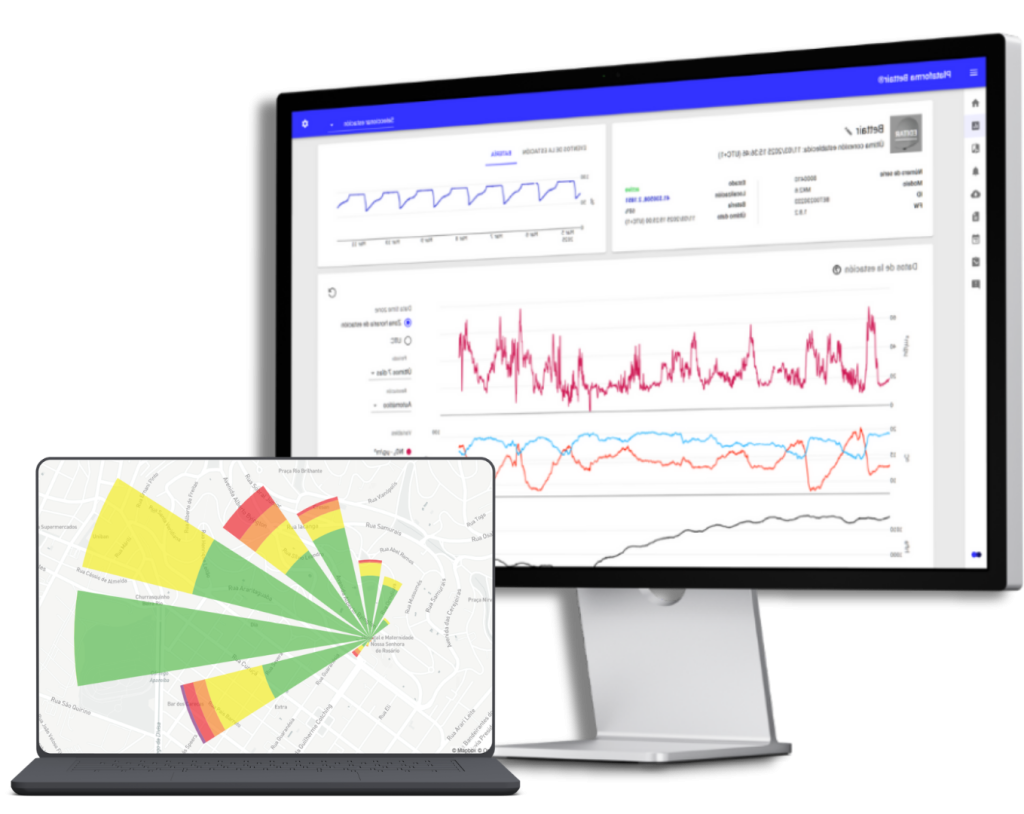
Bettair Platform
Centralize and visualize environmental measurements from distributed Bettair nodes.
Georeferenced data
Visualize measurements by location to understand spatial differences.
Historical trends
Use time-series information to review changes and investigate episodes.
API integration
Platform and API capabilities support integration with wider digital environments.
Why Bettair for Airports
Continuous environmental visibility; spatial information; episode investigation; support for airport environmental management.
Continuous data
Build a time-linked environmental record.
Distributed coverage
Place monitoring where conditions and concerns vary.
Multiparameter monitoring
Combine particles, gases, noise and environmental variables.
Actionable evidence
Support investigation and environmental management.
Applications for Airports
Use Bettair where airports operations require continuous environmental visibility.
Airport Environmental Monitoring
Airport Emissions Monitoring
Environmental Noise Monitoring
Perimeter Environmental Monitoring
Technical Parameters
Select parameters according to the environmental objectives of the airports project.

Particles
✓ PM1 ✓ PM2.5 ✓ PM10
✓ PM40 ✓ PTS
Particles

Gases
✓ NO₂ ✓ NO ✓ CO
✓ CO₂ ✓ O₃ ✓ SO₂
✓ VOC ✓ EVOC ✓ pVOC
✓ NH₃ ✓ H₂S ✓ CH₄
✓ HCl ✓ CH₂O ✓ HF
✓ HCN
Gases

Meteorology
✓ Temperature
✓ Humidity
✓ Pressure
✓ Wind Speed
✓ Wind Direction
and more
Meteorology

Environmental Noise
✓ Environmental Noise
✓ Continuous acoustic monitoring
✓ Environmental noise analysis
Environmental Noise
✓ PM1 ✓ PM2.5 ✓ PM10
✓ PM40 ✓ PTS
✓ NO₂ ✓ NO ✓ CO
✓ CO₂ ✓ O₃ ✓ SO₂
✓ VOC ✓ EVOC ✓ pVOC
✓ NH₃ ✓ H₂S ✓ CH₄
✓ HCl ✓ CH₂O ✓ HF
✓ HCN
✓ Temperature
✓ Humidity
✓ Pressure
✓ Wind Speed
✓ Wind Direction
and more
✓ Environmental Noise
✓ Continuous acoustic monitoring
✓ Environmental noise analysis
Available parameters depend on the selected Bettair configuration and the monitoring objectives of the project.
Monitoring Strategy for Airports
Define objectives, parameters, locations and the evidence required before deployment.
1
Define objectives
Identify the environmental questions and operating conditions relevant to airports.
2
Select parameters
Choose particles, gases, noise and environmental variables according to the monitoring objective.
3
Plan locations
Position nodes across operational areas, boundaries and sensitive receptors.
4
Review and act
Use trends and episode information to support investigation and environmental-management decisions.
The result is a monitoring strategy designed around
the project’s real environmental challenges.
Evidence for Environmental Management
Continuous monitoring creates traceable environmental information for investigation and management.
24+
Continuous monitoring
Time-series measurements provide a persistent environmental record.
7+
Gas selection
Bettair configurations can select multiple gases according to project needs.
API
Data integration
Platform and API capabilities support integration with digital environments.
Technical Evidence
Bettair technical monitoring evidence
Use documented Bettair technical evidence to support the monitoring approach; sector-specific project claims should only be added when independently verified.
Bettair devices
2 Nodes
Project location
Greece
Stakeholder
Heraklion
Project date
2026
More Environmental Monitoring Projects
Explore related Bettair applications and sectors to compare monitoring approaches.
Frequently Asked Questions About Airports
Common questions about environmental monitoring in airports projects.
Can airports monitor both air quality and noise with Bettair?
Yes. Bettair can combine configurable air-quality measurements with noise monitoring, allowing different environmental variables to be observed within the same monitoring infrastructure.
Which pollutants are relevant around airports?
Depending on the monitoring objective, relevant parameters may include NO₂, NO, CO, PM10, PM2.5 and O₃. Aircraft operations, ground vehicles and surrounding traffic should be considered when designing the monitoring strategy.
Can Bettair monitor particulate matter around airports?
Yes. Bettair can continuously monitor PM1, PM2.5 and PM10 at selected airport locations. Distributed measurements can help identify spatial and temporal changes in particulate concentrations around operational areas and sensitive receptors.
Can Bettair monitor environmental noise around airports?
Yes. Bettair can combine configurable air-quality measurements with noise monitoring, allowing environmental teams to observe different environmental conditions within the same distributed monitoring infrastructure.
Where should Bettair nodes be placed at an airport?
Node locations should be defined according to the monitoring objective, considering operational areas, airport boundaries, access roads and relevant sensitive receptors. Distributed placement helps capture spatial differences in environmental conditions.
Can meteorological data help interpret airport air-quality measurements?
Yes. Temperature, humidity, pressure and wind information can provide additional context when analysing changes in air-quality measurements and investigating environmental episodes around airport operations.
Have a specific monitoring requirement for your sector?
Related Content
Explore related sectors and applications to continue through the environmental monitoring ecosystem.
Ports & Maritime
Shared transport-infrastructure challenges include emissions, particulate matter, noise and changing operations.
Explore ApplicationsLow Emission Zones & Urban Mobility
Airport access traffic and surrounding urban areas create overlapping air-quality and noise monitoring needs.
Explore ParametersEnvironmental Consulting & Monitoring
Consultants can incorporate distributed airport measurements into environmental studies and monitoring programmes.
Explore Case StudiesLooking for a monitoring solution for another sector?
Looking for a monitoring solution for another sector?
GET STARTED
Evaluate monitoring for my airport
Assess air quality, noise and environmental monitoring requirements for your airport.
Define the parameters that matter for your project
Select monitoring locations and network strategy
Discuss the environmental data your team needs