
Air Quality and Noise Monitoring for
Urban Mobility & Low Emission Zones
Bettair enables distributed urban monitoring of NO2, PM10, PM2.5 and many more configurable gases and noise according to project requirements. Nodes can be positioned at strategic locations to create continuous spatial and temporal information. Environmental variables help contextualize measurements, supporting analysis of mobility measures, localized episodes, public communication and evidence-based urban environmental management.
Environmental Monitoring Challenges in Low Emission Zones & Urban Mobility
Urban mobility policies require evidence showing how traffic and local conditions influence NO2, PM10 and PM2.5. Sparse monitoring may miss localized patterns, while noise adds another important environmental dimension. Without distributed, continuous information, municipalities may struggle to evaluate measures, investigate episodes, communicate results and prioritize interventions across complex urban areas.
Restricting city traffic triggers instant pushback from drivers and local business owners. A single reference cabin cannot defend your mobility policy. It leaves narrow streets blind. Vehicles simply divert, pushing exhaust plumes and tire noise straight into residential blocks. Bettair mounts directly in any space across key junctions, giving your team street-by-street proof that air improves.
Changing environmental conditions
Environmental conditions can vary by activity, location and meteorology, making isolated measurements difficult to interpret.
Complex operational environments
Low Emission Zones & Urban Mobility sites can contain multiple sources, receptors and operating conditions that require distributed visibility.
Need for continuous evidence
Time-linked data helps investigate episodes, compare locations and support environmental management with traceable evidence.
What to Monitor
Configure the monitoring network around the environmental objectives of the low emission zones & urban mobility project.
1
Particulate Matter
PM1, PM2.5 and PM10 measurements provide continuous visibility into particulate conditions across traffic corridors, urban areas and locations where population exposure is a relevant consideration.
2
Gases & Traffic Emissions
Configurable gas measurements can help characterize traffic-related air-quality conditions, with parameters selected according to the objectives and characteristics of the urban monitoring network.
3
Environmental Noise
Continuous acoustic monitoring can complement urban air-quality measurements by providing visibility into environmental noise around traffic corridors, mobility infrastructure and sensitive urban locations.
4
Environmental Conditions
Temperature, humidity, pressure and wind measurements provide context for interpreting changes in urban air quality and understanding how environmental conditions influence pollutant dispersion.
How Bettair Works
Bettair enables distributed urban monitoring of NO2, PM10, PM2.5, configurable gases and noise according to project requirements. Nodes can be positioned at strategic locations to create continuous spatial and temporal information. Environmental variables help contextualize measurements, supporting analysis of mobility measures, localized episodes, public communication and evidence-based urban environmental management.
Distributed nodes
Place nodes at operational areas, boundaries and sensitive locations according to the monitoring objective for low emission zones & urban mobility.
Continuous measurements
Collect time-series environmental data to identify changes, compare locations and investigate episodes.
Contextual environmental data
Combine particles, selected gases, noise and environmental variables where relevant.
Continuous Environmental Monitoring
Distributed data; temporal analysis; support for mobility decisions; objective information for environmental management.
See changes over time
Compare locations
Investigate episodes
Bettair Platform
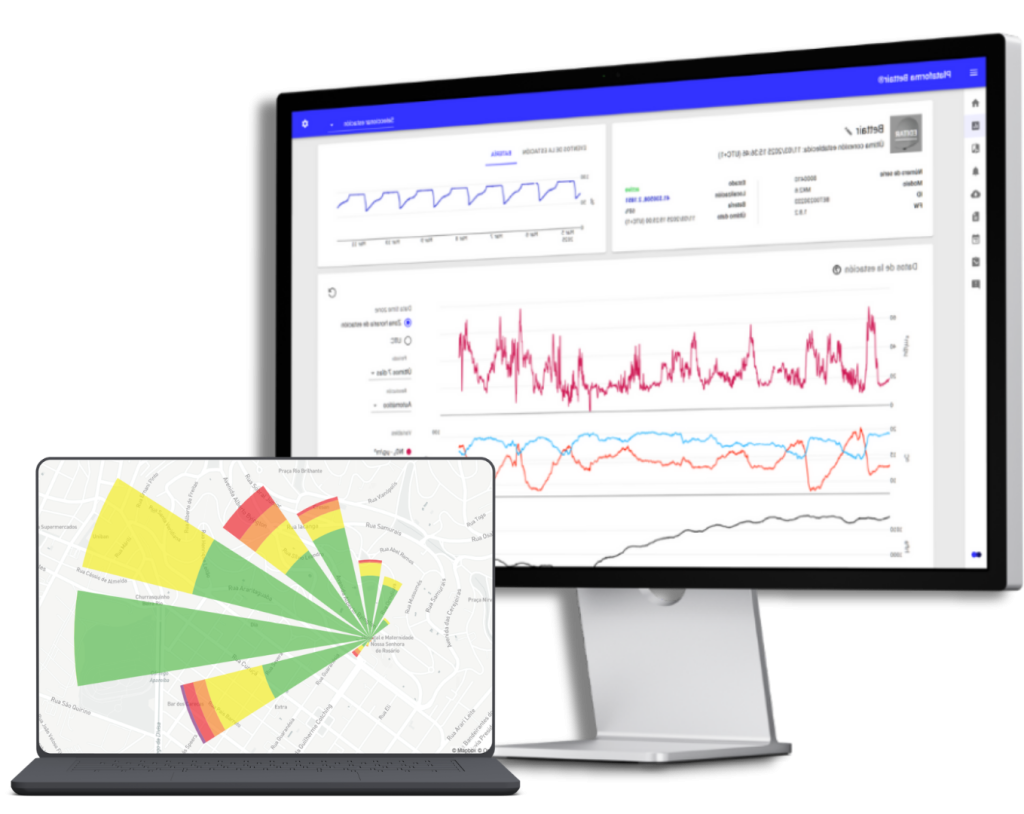
Centralize and visualize environmental measurements from distributed Bettair nodes.
Georeferenced data
Visualize measurements by location to understand spatial differences.
Historical trends
Use time-series information to review changes and investigate episodes.
API integration
Platform and API capabilities support integration with wider digital environments.
Why Bettair for Low Emission Zones & Urban Mobility
Distributed data; temporal analysis; support for mobility decisions; objective information for environmental management.
Continuous data
Build a time-linked environmental record.
Distributed coverage
Place monitoring where conditions and concerns vary.
Multiparameter monitoring
Combine particles, gases, noise and environmental variables.
Actionable evidence
Support investigation and environmental management.
Applications for Low Emission Zones & Urban Mobility
Use Bettair where low emission zones & urban mobility operations require continuous environmental visibility.
LEZ / Urban Mobility Air Quality Monitoring
Urban Air Quality Monitoring
Environmental Noise Monitoring
Perimeter Environmental Monitoring
Technical Parameters
Select parameters according to the environmental objectives of the low emission zones & urban mobility project.

Particles
✓ PM1
✓ PM2.5
✓ PM10
Particles

Gases
✓ NO₂ ✓ NO ✓ CO
✓ O₃ ✓ SO₂ ✓ VOC
and more
Gases

Meteorology
✓ Temperature
✓ Humidity
✓ Pressure
✓ Wind Speed
✓ Wind Direction
and more
Meteorology

Environmental Noise
✓ Environmental Noise
✓ Continuous acoustic monitoring
✓ Environmental noise analysis
Environmental Noise
✓ PM1
✓ PM2.5
✓ PM10
✓ NO₂ ✓ NO ✓ CO
✓ O₃ ✓ SO₂ ✓ VOC
and more
✓ Temperature
✓ Humidity
✓ Pressure
✓ Wind Speed
✓ Wind Direction
and more
✓ Environmental Noise
✓ Continuous acoustic monitoring
✓ Environmental noise analysis
Available parameters depend on the selected Bettair configuration and the monitoring objectives of the project.
Monitoring Strategy for Low Emission Zones & Urban Mobility
Define objectives, parameters, locations and the evidence required before deployment.
1
Define objectives
Identify the environmental questions and operating conditions relevant to low emission zones & urban mobility.
2
Select parameters
Choose particles, gases, noise and environmental variables according to the monitoring objective.
3
Plan locations
Position nodes across operational areas, boundaries and sensitive receptors.
4
Review and act
Use trends and episode information to support investigation and environmental-management decisions.
The result is a monitoring strategy designed around
the project’s real environmental challenges.
Evidence for Environmental Management
Continuous monitoring creates traceable environmental information for investigation and management.
24+
Continuous monitoring
Time-series measurements provide a persistent environmental record.
7+
Gas selection
Bettair configurations can select multiple gases according to project needs.
API
Data integration
Platform and API capabilities support integration with digital environments.
Technical Evidence
Bettair technical monitoring evidence
Use documented Bettair technical evidence to support the monitoring approach; sector-specific project claims should only be added when independently verified.
Bettair devices
+200 Nodes
Project location
Spain
Stakeholder
Spain Cities
Project date
2019/2026
More Environmental Monitoring Projects
Explore related Bettair applications and sectors to compare monitoring approaches.
Frequently Asked Questions About Low Emission Zones & Urban Mobility
Common questions about environmental monitoring in low emission zones & urban mobility projects.
What pollutants should be monitored in a Low Emission Zone?
NO₂, PM10 and PM2.5 are particularly relevant to traffic-related urban air-quality assessment. Depending on the project, additional gases, O₃, CO, noise and meteorological variables can provide further context.
Can Bettair be used in a LEZ / Urban mobility monitoring network?
Bettair can be deployed as part of a distributed urban monitoring network, providing continuous measurements at selected locations. The network’s regulatory role and measurement methodology must be defined according to the applicable jurisdiction.
Can Bettair monitor air quality across different traffic corridors?
Yes. Bettair can be deployed as part of a distributed urban monitoring network, providing continuous measurements at selected locations where traffic patterns, population exposure and environmental conditions may differ.
Which parameters are most relevant for urban mobility monitoring?
NO₂, PM10 and PM2.5 are particularly relevant to traffic-related urban air-quality assessment. Depending on the project, additional gases, O₃, CO, noise and meteorological variables can provide further context.
Can Bettair monitor noise as part of an urban mobility network?
Yes. Bettair can be configured for environmental noise monitoring alongside air-quality measurements, allowing mobility projects to evaluate multiple environmental dimensions through distributed monitoring.
Can Bettair support monitoring around a Low Emission Zone?
Yes. Bettair can provide continuous measurements at selected locations within or around an LEZ. The regulatory role and measurement methodology must be defined according to the applicable jurisdiction and project requirements.
Have a specific monitoring requirement for your sector?
Related Content
Explore related sectors and applications to continue through the environmental monitoring ecosystem.
Smart Cities
LEZ monitoring fits naturally within wider Smart City environmental data and urban decision systems.
Explore ApplicationsAirports
Airport access traffic and nearby urban areas create overlapping air-quality and noise monitoring needs.
Explore ParametersPorts & Maritime
Ports are major mobility and logistics environments where traffic, emissions and noise affect surrounding areas.
Explore Case StudiesLooking for a monitoring solution for another sector?
Looking for a monitoring solution for another sector?
GET STARTED
Evaluate a monitoring network for my city
Define the monitoring strategy for air quality, noise and urban environmental conditions.
Define the parameters that matter for your project
Select monitoring locations and network strategy
Discuss the environmental data your team needs