
Continuous Dust and Emissions Monitoring for Cement Plants
Heavy dust clouds travel fast across quarry gates, clinker coolers, and boundary lines. Surrounding towns notice immediately. When neighbors complain or local agencies demand answers, point samples taken weeks ago will not protect plant operations. You need continuous facts. Bettair tracks fugitive dust and kiln gases right along your perimeter fence line. The network operates without routine manual intervention, delivering undisputed records that prove your dust suppression works around the clock.
Environmental Monitoring Challenges in Cement Plants
Cement production involves kilns, clinker handling, crushing, grinding, storage and internal transport. These operations can generate PM10, PM2.5 and larger particle fractions, alongside gases and noise. Without continuous perimeter information, environmental teams may struggle to identify episodic emissions, investigate complaints, evaluate controls and maintain records around plant boundaries and receptors.
Cement manufacturing releases massive dust volumes from blasting, truck hauling, and primary crushing before raw mix ever reaches the preheater tower. High-temperature kiln firing and clinker grinding add continuous combustion plumes of nitrogen oxides and sulfur compounds. These emissions fluctuate wildly with raw meal composition, fuel swaps, and sudden thermal shifts. Traditional reference stations installed at a single boundary point leave massive blind spots along the facility perimeter. When dry winds carry particulate matter toward nearby farmland or residential areas, plant personnel cannot tell whether the dust originated from internal open storage piles, unpaved haul tracks, or external regional soil resuspension. This lack of spatial tracking creates major compliance vulnerabilities. It forces management to react defensively to community friction without knowing the true physical source or the precise operational timestamp of the dust event.
Changing environmental conditions
Environmental conditions can vary by activity, location and meteorology, making isolated measurements difficult to interpret.
Complex operational environments
Cement Plants sites can contain multiple sources, receptors and operating conditions that require distributed visibility.
Need for continuous evidence
Time-linked data helps investigate episodes, compare locations and support environmental management with traceable evidence.
What to Monitor
Configure the monitoring network around the environmental objectives of the cement plants project.
1
Particulate Matter
PM1, PM2.5 and PM10 measurements provide continuous visibility into particulate conditions associated with cement production, clinker handling, material transfer and plant perimeter areas.
2
Gases & Emissions
Configurable gas measurements can help characterize emissions associated with cement production and related processes, with parameters selected according to the plant configuration and monitoring objectives.
3
Environmental Noise
Continuous acoustic monitoring helps characterize noise from production equipment, material handling, transport and other operational activities around cement plants.
4
Environmental Conditions
Temperature, humidity, pressure and wind measurements provide context for interpreting particulate and emission conditions and understanding dispersion around production and perimeter areas.
How Bettair Works
Bettair nodes can be distributed around plant boundaries and relevant process areas to monitor PM1, PM2.5 and PM10 continuously, while PM+ can extend particle monitoring to PM40 and PTS. Configurable gases, noise and environmental variables provide additional context, helping teams investigate episodes, evaluate controls and maintain perimeter records for management.
Distributed nodes
Place nodes at operational areas, boundaries and sensitive locations according to the monitoring objective for cement plants.
Continuous measurements
Collect time-series environmental data to identify changes, compare locations and investigate episodes.
Contextual environmental data
Combine particles, selected gases, noise and environmental variables where relevant.
Continuous Environmental Monitoring
Continuous perimeter monitoring; episode identification; environmental traceability; support for corrective measures.
See changes over time
Compare locations
Investigate episodes
Bettair Platform
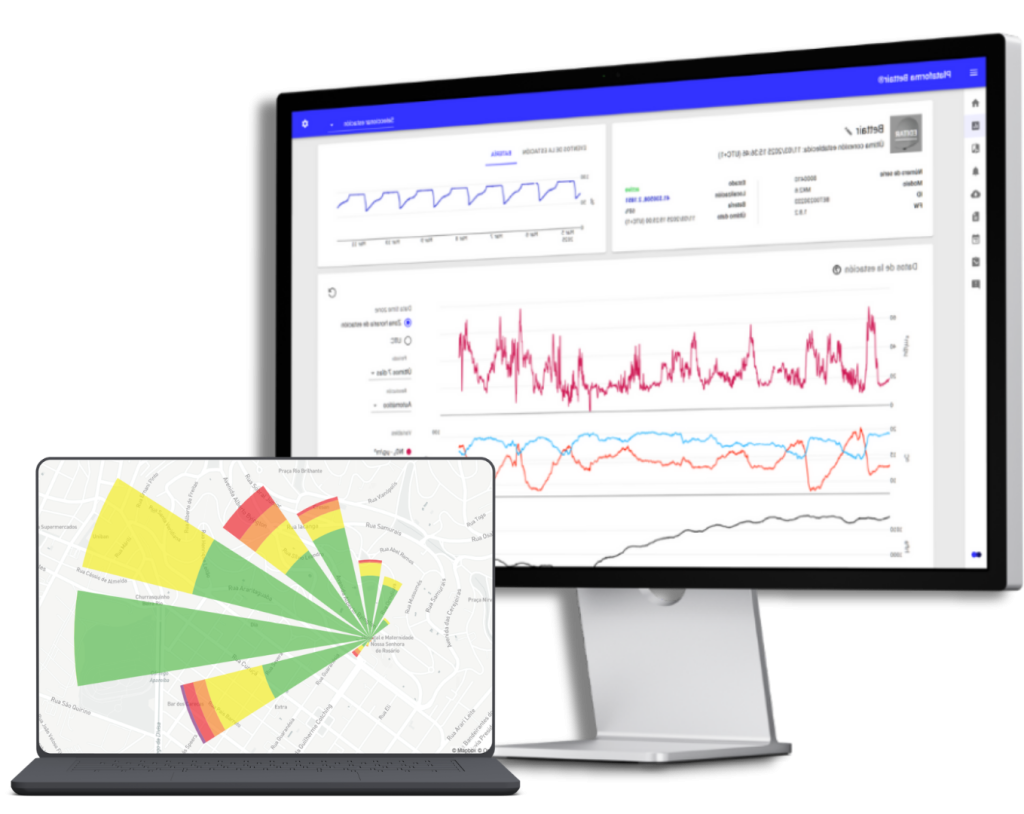
Centralize and visualize environmental measurements from distributed Bettair nodes.
Georeferenced data
Visualize measurements by location to understand spatial differences.
Historical trends
Use time-series information to review changes and investigate episodes.
API integration
Platform and API capabilities support integration with wider digital environments.
Why Bettair for Cement Plants
Continuous perimeter monitoring; episode identification; environmental traceability; support for corrective measures.
Continuous data
Build a time-linked environmental record.
Distributed coverage
Place monitoring where conditions and concerns vary.
Multiparameter monitoring
Combine particles, gases, noise and environmental variables.
Actionable evidence
Support investigation and environmental management.
Applications for Cement Plants
Use Bettair where cement plants operations require continuous environmental visibility.
Cement Dust Monitoring
Perimeter Environmental Monitoring
Industrial Emissions Monitoring
Environmental Noise Monitoring
Technical Parameters
Select parameters according to the environmental objectives of the cement plants project.

Particles
✓ PM1 ✓ PM2.5 ✓ PM10
✓ PM40 ✓ PTS
Particles

Gases
✓ NO2 ✓ NO ✓ CO
✓ CO2 ✓ SO2 ✓ O3
✓ NH3 ✓ H2S ✓ CH4
✓ VOC ✓ EVOC ✓ pVOC
✓ HCl ✓ CH2O ✓ HF
✓ HCN
Gases

Meteorology
✓ Temperature
✓ Humidity
✓ Pressure
✓ Wind Speed
✓ Wind Direction
and more
Meteorology

Environmental Noise
✓ Environmental Noise
✓ Continuous acoustic monitoring
✓ Environmental noise analysis
Environmental Noise
✓ PM1 ✓ PM2.5 ✓ PM10
✓ PM40 ✓ PTS
✓ NO2 ✓ NO ✓ CO
✓ CO2 ✓ SO2 ✓ O3
✓ NH3 ✓ H2S ✓ CH4
✓ VOC ✓ EVOC ✓ pVOC
✓ HCl ✓ CH2O ✓ HF
✓ HCN
✓ Temperature
✓ Humidity
✓ Pressure
✓ Wind Speed
✓ Wind Direction
and more
✓ Environmental Noise
✓ Continuous acoustic monitoring
✓ Environmental noise analysis
Available parameters depend on the selected Bettair configuration and the monitoring objectives of the project.
Monitoring Strategy for Cement Plants
Define objectives, parameters, locations and the evidence required before deployment.
1
Define objectives
Identify the environmental questions and operating conditions relevant to cement plants.
2
Select parameters
Choose particles, gases, noise and environmental variables according to the monitoring objective.
3
Plan locations
Position nodes across operational areas, boundaries and sensitive receptors.
4
Review and act
Use trends and episode information to support investigation and environmental-management decisions.
The result is a monitoring strategy designed around
the project’s real environmental challenges.
Evidence for Environmental Management
Continuous monitoring creates traceable environmental information for investigation and management.
24+
Continuous monitoring
Time-series measurements provide a persistent environmental record.
7+
Gas selection
Bettair configurations can select multiple gases according to project needs.
API
Data integration
Platform and API capabilities support integration with digital environments.
Technical Evidence
Bettair technical monitoring evidence
Use documented Bettair technical evidence to support the monitoring approach; sector-specific project claims should only be added when independently verified.
Bettair devices
N/A
Project location
Global
Stakeholder
Bettair
Project date
N/A
More Environmental Monitoring Projects
Explore related Bettair applications and sectors to compare monitoring approaches.
Frequently Asked Questions About Cement Plants
Common questions about environmental monitoring in cement plants projects.
Why is PM10 important around cement plants?
Cement production, clinker handling, crushing, grinding and material transport can generate particulate matter. PM10 monitoring can help characterize changes in particulate concentrations around operational and perimeter areas.
Can Bettair monitor particulate matter around a cement plant perimeter?
Yes. Bettair nodes can be positioned at selected perimeter locations to continuously monitor PM1, PM2.5 and PM10. PM+ can extend particle-size monitoring to larger fractions when the configuration requires it.
Can Bettair monitor emissions around cement plant operations?
Bettair can monitor selected gases and particulate matter according to the project configuration. This can provide continuous environmental information around operational and perimeter areas.
Where should environmental monitoring nodes be placed around a cement plant?
Locations should be selected according to the monitoring objective, considering plant boundaries, material-handling areas, operational sources and sensitive receptors. Distributed nodes help capture spatial differences across the site.
Can Bettair monitor noise at cement plants?
Yes. Environmental noise can be monitored alongside air-quality parameters, providing additional information about conditions around plant operations, logistics and relevant perimeter areas.
Can meteorological data help interpret cement plant monitoring results?
Yes. Wind speed and direction, together with temperature, humidity and pressure, can provide useful context when analysing changes in particulate and gas measurements around cement plant operations.
Have a specific monitoring requirement for your sector?
Related Content
Explore related sectors and applications to continue through the environmental monitoring ecosystem.
Mining & Extractives
Quarries and cement plants share particulate, perimeter, material-handling and environmental monitoring challenges.
Explore ApplicationsManufacturing & Industry
Cement plants are industrial facilities where process emissions, particles and noise require continuous visibility.
Explore ParametersConstruction
Cement and construction environments share dust-management and particulate-monitoring requirements.
Explore Case StudiesLooking for a monitoring solution for another sector?
Looking for a monitoring solution for another sector?
GET STARTED
Evaluate monitoring for my plant
Assess particulate, gas, noise and environmental monitoring requirements around your facility.
Define the parameters that matter for your project
Select monitoring locations and network strategy
Discuss the environmental data your team needs