
Environmental Monitoring for Mining & Extractives
Continuous particulate, air quality and environmental monitoring for mines, quarries and extractive operations where dust, noise and changing site conditions require clear, distributed data.
Environmental Monitoring Challenges in Mining
Mining and quarrying operations can generate particulate emissions through extraction, crushing, screening, hauling and material handling across large areas.
Dust and noise conditions can change with production activity, vehicle movements, weather and site geometry. Distributed monitoring provides continuous evidence from operational areas, perimeters and sensitive receptors.
Particulate emissions
Extraction, crushing, screening, haul roads and material handling can create changing particulate conditions that require continuous visibility.
Large and variable sites
Mining operations can cover extensive areas, making distributed monitoring useful for understanding differences between sources, perimeters and receptors.
Operational evidence
Continuous environmental records can support dust management, stakeholder communication and evidence-based operational decisions.
Environmental Parameters for Mining Operations
Bettair can be configured around particulate matter as a primary monitoring focus, with selected gases, noise and meteorological variables added when relevant to the operation.
1
Particulate Matter
PM1, PM2.5 and PM10 measurements provide continuous visibility into particulate conditions generated by extraction, crushing, haulage, material handling and other mining activities.
2
Gases & Process Context
Configurable gas measurements can provide additional information about emissions associated with equipment, processing activities and specific sources identified within mining and quarry operations.
3
Environmental Noise
Continuous acoustic monitoring helps characterize noise from machinery, crushing, transport and other operational activities across extraction areas, facilities and surrounding locations.
4
Wind & Conditions
Temperature, humidity, pressure and wind measurements help interpret particulate dispersion and changing environmental conditions across extraction areas, perimeters and nearby receptors.
How Bettair Works for Mining Monitoring
Bettair combines distributed monitoring nodes with connected data tools to build a continuous environmental view across mining and quarry operations.
Define the sources and receptors
Identify extraction, crushing, haulage, storage, perimeter and receptor areas that are relevant to the monitoring objective.
Deploy a distributed network
Place nodes at representative operational and perimeter locations to capture differences across the site.
Analyze continuous conditions
Use connected data and historical trends to investigate particulate episodes, operational patterns and changing environmental conditions.
Continuous Environmental Monitoring for Mining and Quarry Environments
Continuous environmental data helps teams understand changing conditions across mining operations and quarry environments, with measurements matched to project objectives and selected monitoring locations.
Time-based visibility
Distributed monitoring
Traceable environmental data
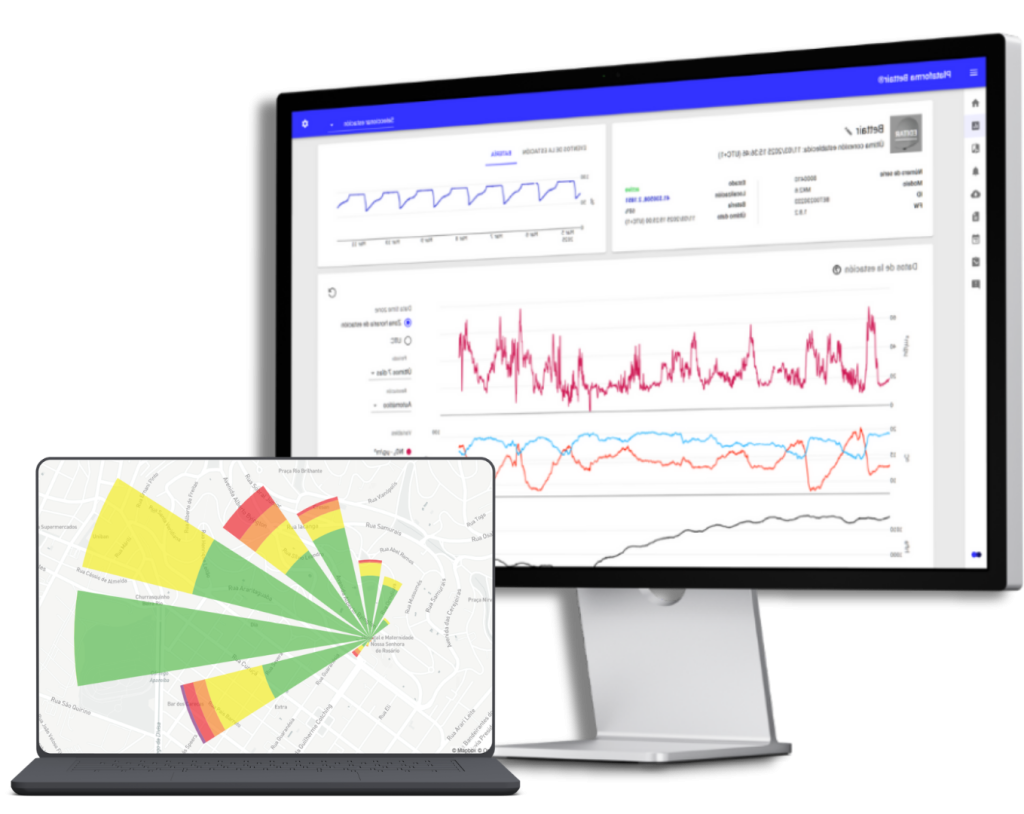
Bettair Cloud for Environmental Data
Bettair connects distributed monitoring nodes with a digital environment for viewing, analyzing and integrating environmental data.
Georeferenced data
View measurements by location to understand spatial differences across the monitored area.
Analysis tools
Review historical data, trends and environmental episodes through a centralized platform.
API integration
Connect Bettair data with external platforms and digital systems through API capabilities.
Why Use Bettair for Environmental Monitoring?
Bettair combines configurable multi-parameter sensing, connected nodes and a centralized data environment for continuous environmental monitoring.
Continuous monitoring
Collect environmental data continuously to build a time-based view of changing conditions.
Multi-parameter configuration
Combine particulate matter, selected gases, noise and environmental variables according to project requirements.
Connected infrastructure
Deploy distributed nodes and bring measurements together in a centralized digital environment.
Scalable data architecture
Use multiple monitoring points and integrate data into wider environmental or operational workflows.
Environmental Monitoring Applications for Mining & Extractives
Bettair can be configured for different monitoring objectives across mining operations and quarry environments, from source and perimeter locations to sensitive receptors.
Mining Dust Monitoring
Perimeter Environmental Monitoring
Environmental Noise Monitoring
Network Monitoring
Environmental Parameters Available Across Bettair Configurations
Particulate matter, selected gases, noise and environmental variables can be combined according to project requirements and the selected Bettair configuration.

Particulate Matter
✓ PM1 ✓ PM2.5 ✓ PM10
✓ PM40 ✓ PTS
Particulate Matter

Gases
✓ NO2 ✓ NO ✓ CO
✓ CO2 ✓ SO2 ✓ NH3
✓ H2S ✓ CH4 ✓ VOC
✓ EVOC ✓ pVOC ✓ O3
✓ HCl ✓ CH2O ✓ HF
✓ HCN
Gases

Environmental Parameters
✓ Temperature
✓ Humidity
✓ Pressure
✓ Wind Speed
✓ Wind Direction
Environmental Parameters

Noise
✓ Environmental Noise
✓ Continuous acoustic monitoring
✓ Environmental noise analysis
Noise
✓ PM1 ✓ PM2.5 ✓ PM10
✓ PM40 ✓ PTS
✓ NO2 ✓ NO ✓ CO
✓ CO2 ✓ SO2 ✓ NH3
✓ H2S ✓ CH4 ✓ VOC
✓ EVOC ✓ pVOC ✓ O3
✓ HCl ✓ CH2O ✓ HF
✓ HCN
✓ Temperature
✓ Humidity
✓ Pressure
✓ Wind Speed
✓ Wind Direction
✓ Environmental Noise
✓ Continuous acoustic monitoring
✓ Environmental noise analysis
Available parameters depend on the selected Bettair configuration and the monitoring objectives of the project.
How to Build an Environmental Monitoring Strategy
A practical monitoring strategy starts with the project objective, then connects locations, parameters and continuous data to the environmental questions that matter across mining operations and quarry environments.
1
Define the objective
Identify the environmental question, potential sources and sensitive receptors relevant to mining operations and quarry environments.
2
Select monitoring locations
Place nodes at representative operational, perimeter or receptor locations according to the monitoring objective.
3
Configure the parameters
Select particulate, gas, noise and environmental variables according to the project requirements.
4
Review and interpret the data
Use continuous data, historical trends and episode analysis to understand changes and support environmental decisions.
The result is a monitoring strategy designed around
the project’s real environmental challenges.
Evidence and Technical Confidence
Bettair combines established monitoring capabilities with connected data infrastructure to support demanding environmental projects.
24/7
Continuous data
Continuous monitoring provides a time-based view of particulate episodes and changing environmental conditions.
PM10
Lead parameter
PM10 is a key particulate fraction for many mining, quarrying and material-handling monitoring objectives.
IoT
Distributed nodes
Networked nodes provide measurements from multiple points around the operation.
Relevant Bettair Experience
Bettair AIRLAB Microsensors Challenge 2023
Bettair achieved first place in the overall outdoor multi-pollutant sensor category in the AIRLAB Microcapteurs 2023 challenge, with testing performed in France and Thailand.
Bettair devices
Project location
France and Thailand
Stakeholder
Airparif / AIRLAB
Project date
2023
Explore More Bettair Projects
Discover how Bettair monitoring infrastructure is used across cities, infrastructure, industrial environments and other demanding applications.
Frequently Asked Questions About Mining & Extractives Monitoring
Common questions about using Bettair for continuous environmental monitoring across mining operations and quarry environments.
Which parameter is most relevant for mining dust monitoring?
PM10 is commonly important for coarse particulate matter associated with mining, quarrying, crushing and material handling.
Can Bettair monitor dust around a quarry perimeter?
Yes. Nodes can be deployed at selected perimeter locations to provide continuous particulate data.
Can monitoring be related to wind and activity?
Continuous measurements can be interpreted alongside wind, humidity and operational information to investigate episodes.
Can mining sites monitor noise as well?
Yes. Environmental noise monitoring can be added where machinery, crushing or transport make acoustic conditions relevant.
Can PM40 and PTS be measured?
PM40 and PTS are available through the PM+ configuration; the exact configuration should be defined for the project.
Where should mining nodes be placed?
Locations should reflect emission sources, perimeter conditions, sensitive receptors, site geometry and the monitoring objectives.
Have a specific monitoring requirement for your sector?
Related Bettair Resources
Explore related Bettair sectors, applications and environmental monitoring resources.
Ports & Maritime
Environmental monitoring for complex industrial and logistics environments.
Explore ApplicationsMining Dust Monitoring
Continuous particulate monitoring for mining and quarry environments.
Explore ParametersPerimeter Environmental Monitoring
Distributed monitoring around operational and receptor locations.
Explore Case StudiesLooking for a monitoring solution for another sector?
Looking for a monitoring solution for another sector?
GET STARTED
Ready to Monitor Your Mining Operation?
Discuss your operation with our team and define a monitoring strategy for particulate matter, noise and environmental conditions.
Continuous environmental monitoring
Multi-parameter environmental data
Monitoring networks tailored to your project